
This 50-person ecommerce marketing agency had scattered AI tools, no standards, and roughly half of all output needed heavy editing or full rewrites before client delivery—what we call rework. Leadership had no visibility into who was using what or whether it worked.
Agency Intelligence deployed a unified platform with role based agents, department specific prompts, and secure client knowledge bases. The rollout happened over 90 days. Chat and client knowledge bases shipped in month one, prompts and agents in month two, with 90% adoption by month three.
The result was 90% daily usage across the team, with rework down from an estimated 1 in 2 outputs to about 1 in 10 based on team feedback. The agency saw 40-80% efficiency gains versus manual workflows, consolidated tool subscriptions, reclaimed margin, and gained full visibility into usage and ROI.
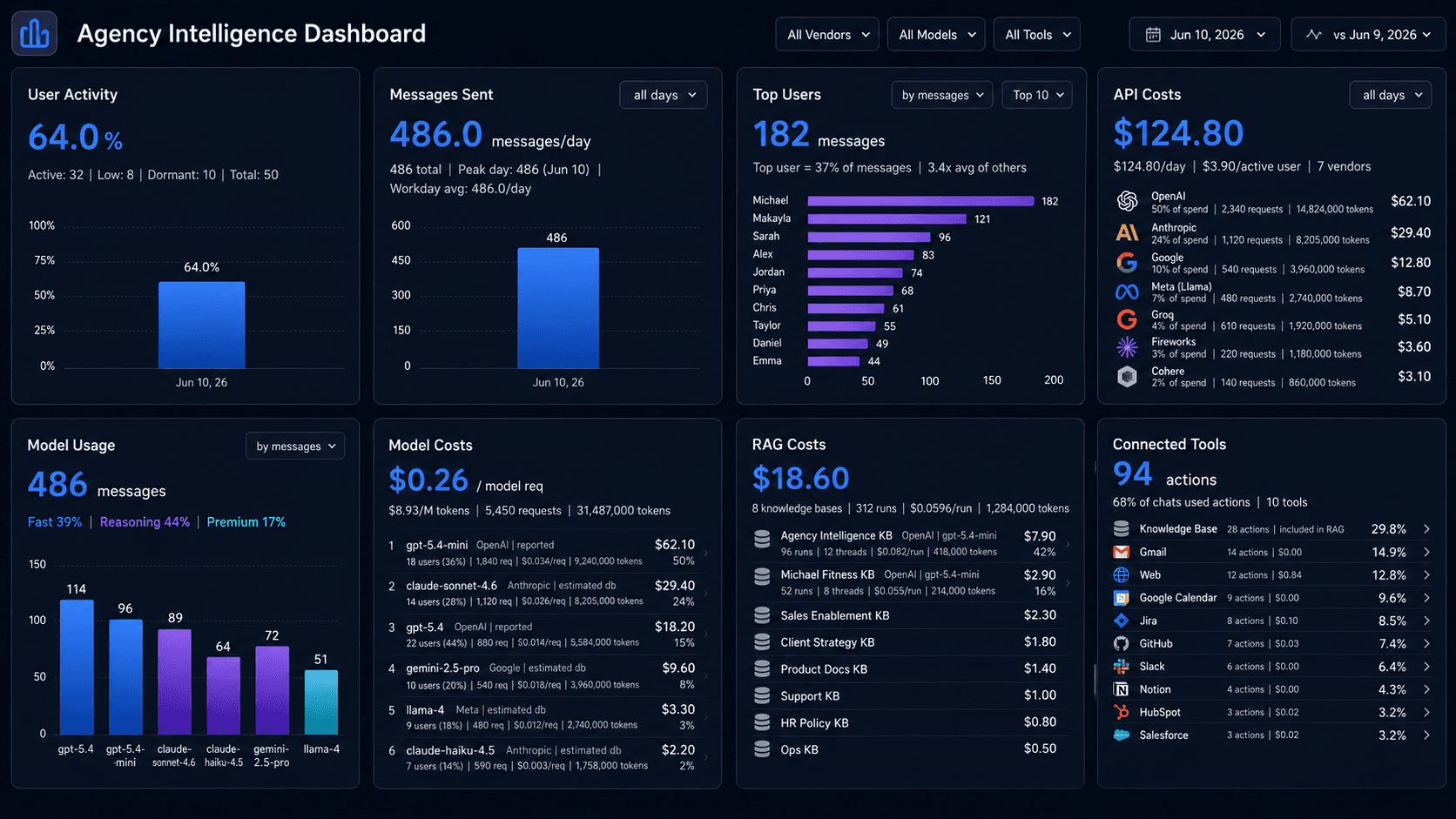
What leadership could finally see
The biggest operational change was visibility. Adoption, cost, and workflow usage were measurable by department and client.
The Agency
This is a full-service marketing agency serving ecommerce brands. They have been in business for 10 years and employ about 50 people across strategy, media buying, content production, and account management. They cover SEO, paid advertising, social media, marketplace management, content production, and campaign execution.
They were growing fast and adding clients, but their delivery workflows did not scale. The team mix included strategists, media buyers, content creators, and account managers, all working to increase output without adding headcount.
The Problem: Tool Sprawl and Inconsistent Output
- Different teams used different tools and accounts
- No shared prompt standards or workflow templates
- Leadership had no visibility into usage or cost
- AI output quality varied by person and department
Output was often generic, off brand, or inaccurate. Roughly half of AI generated content required heavy editing or full rewrites before it was client ready. Time that should have gone to new client work got consumed by fixing AI output.
The Solution: One Platform, Prompt Library, Agents, & Knowledge Bases
Agency Intelligence deployed AI Chat as a single, secure platform to replace scattered tools. It ran on a private infrastructure with isolated knowledge bases per client.
Prompt libraries standardized inputs and output formats across SEO, paid ads, social media, content production, and account management teams. Each team got proven prompts for their specific workflows.
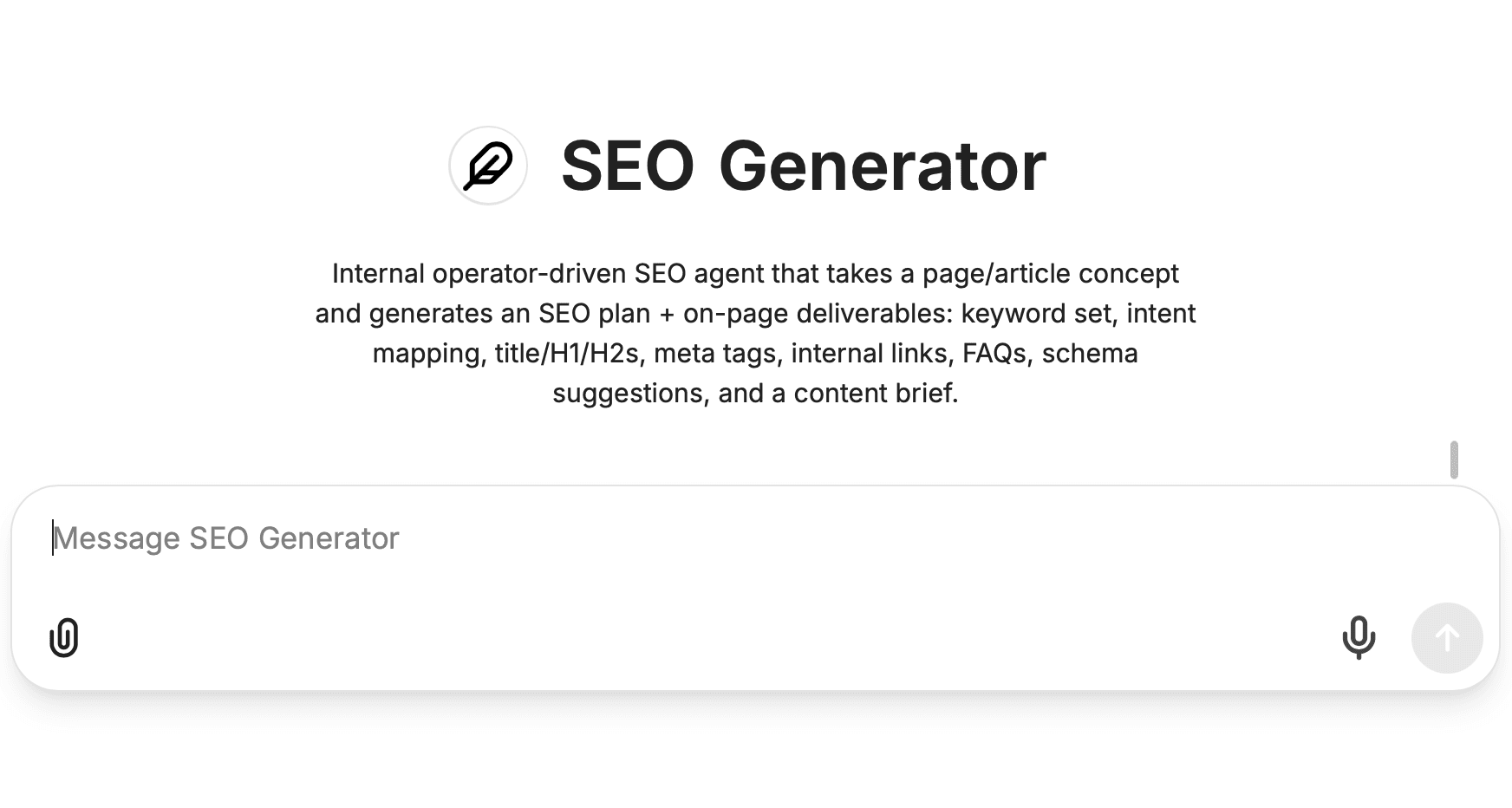
Task based agents automated individual deliverables like SEO audits, campaign briefs, social content calendars, proposal generation, and performance reports. Agents stopped for approval at the points that usually produce rework.
Rollout sequencing
The Results
By the end of month three, 90% of the team used the platform daily. Output improved, with minimal editing required. Based on team feedback, rework dropped from roughly 1 in 2 outputs to about 1 in 10.
- Higher first-pass quality and fewer revisions
- Faster turnaround without adding headcount
- Standardized workflows across departments
- Visibility into adoption by department
- Usage and cost tracked centrally
- Clearer ROI narrative tied to delivery
What Made It Work
Standards beat tool choice
Centralizing access with standards created shared workflows, governance, and measurable usage.
Approval gates beat cleanup
Automation with checkpoints caught problems early, not at the end when rework is most expensive.
Private infrastructure unlocked adoption
Private hosting and isolated client databases let teams move fast without data security risk.
Want agencywide adoption without sacrificing quality?
We help you map your rollout, build department specific prompt libraries and task based agents, and deploy secure knowledge bases. Your team gets standardized workflows, consistent outputs, and measurable results in 90 days.