
Your agency already knows which work repeats. Campaign briefs. Blog articles. Ad variants. Client reports. The problem is not identifying what repeats. The problem is that every execution can still feel like starting from scratch.
Teams rebuild prompts, gather the same client context, search for brand rules, and reconstruct processes that already exist somewhere in the agency. Quality drifts because the process depends too much on who is doing the work and which AI tool they are using.
That changes when the agency turns its knowledge, methods, tools, and approval steps into reusable AI workflows.
Why chat alone does not make agency work repeatable
ChatGPT, Claude, Gemini, and other AI platforms are becoming increasingly capable business tools. They can work with company knowledge, connect to external systems, use tools, and support increasingly sophisticated AI workflows.
The agency challenge is more specific.
Agencies need to operationalize their knowledge, methods, workflows, tools, and client controls consistently across teams, clients, and AI interfaces.
When those capabilities are configured separately across individual AI products, workspaces, and conversations, agencies still have to recreate and manage much of the operating layer around them.
Repeatable agency work requires a shared layer that sits across the AI stack.
What reusable AI workflows do differently
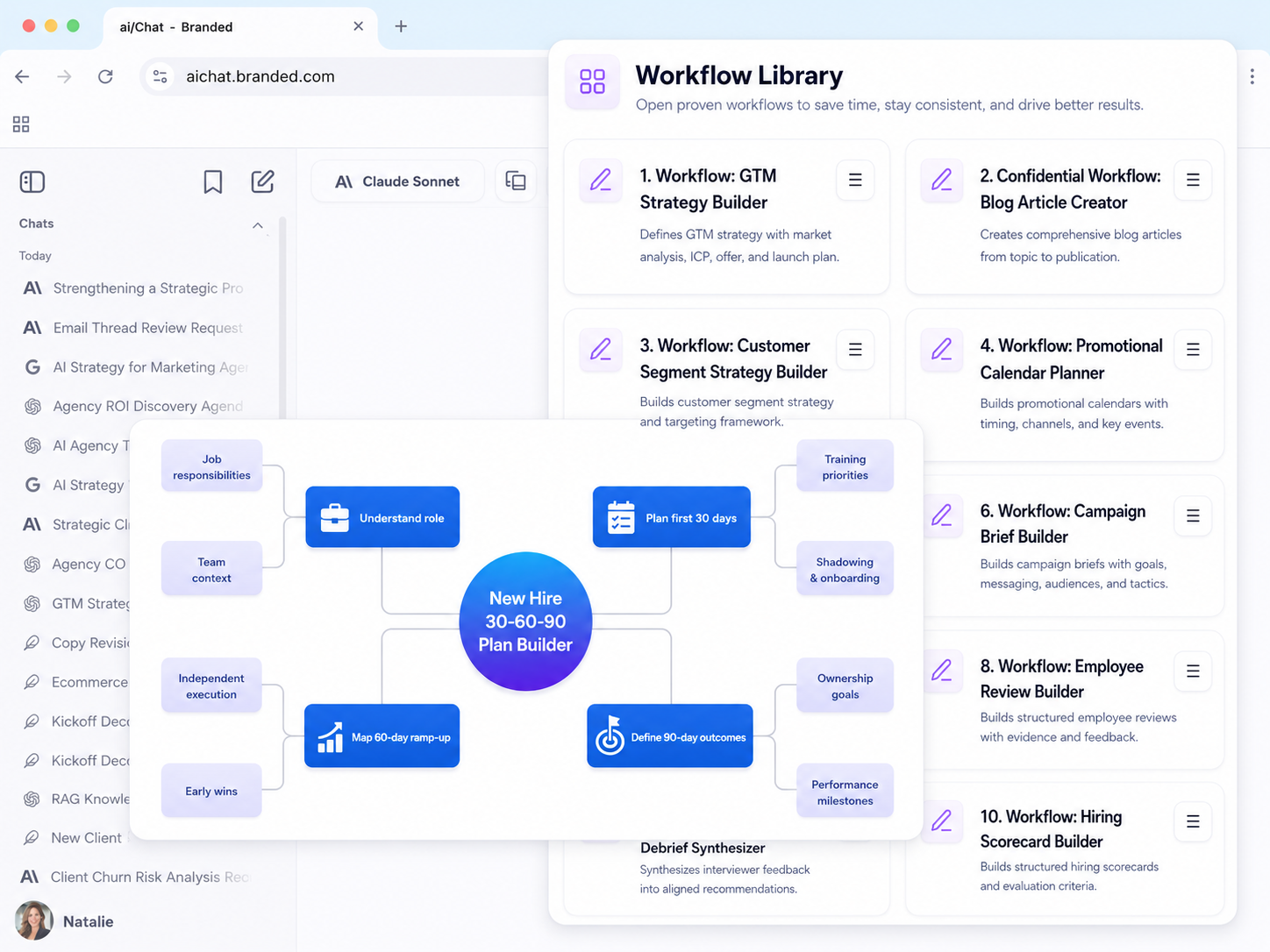
AI workflows turn repeatable agency processes into reusable production systems. The workflow defines the intake, context, instructions, execution steps, review points, approvals, and handoffs needed to complete the work.
Every team member can start from the same process. Every deliverable can use the same approved knowledge and methods. AI can handle appropriate execution steps while people remain responsible for strategy, judgment, review, and approval.
The workflow also does not need to belong to a single chat interface. The agency owns the process and the capabilities behind it rather than rebuilding them around each user, client, model, or AI product.
Agency Intelligence centralizes those reusable capabilities across shared knowledge, workflows, tools, and operating logic. ai/Chat provides one interface for using them, but the underlying capabilities are designed to extend beyond a single chat experience.
From brief to draft to publish
Step 1: Structure the intake
The workflow can collect the same information a senior team member would ask for: audience, objective, core message, required assets, constraints, proof points, and brand considerations.
The process is defined centrally and can be updated once instead of being reconstructed inside individual prompts. Each run starts with the information required for the work rather than relying on memory or guesswork.
Step 2: Execute with the right AI
Once the process and context are defined, AI becomes an execution choice rather than the operating system itself. A workflow can use the model appropriate for the task, cost, speed, or quality requirements.
Teams using ai/Chat can work across multiple models and compare outputs when that improves the work. Other workflows may use a single model or execute through another connected AI interface. The underlying agency process remains consistent.
Step 3: Ground the work in governed knowledge
Client facts, past deliverables, brand standards, approved constraints, and agency methods can come from a shared knowledge layer instead of being recreated inside every prompt.
Knowledge can remain isolated by agency, client, and permission while supporting multiple workflows and AI interfaces. When approved source material changes, the systems that depend on that knowledge can use the current context without every user rebuilding it manually.
Step 4: Connect execution and approval
A workflow can continue beyond generating a draft. Connected tools can handle appropriate execution steps like formatting, creating tasks, updating systems, or preparing downstream actions.
Human approval points remain part of the workflow wherever judgment, client sensitivity, accuracy, or authorization requires them. Automation handles repeatable execution without removing accountability.
What the workflow looks like in practice
Consider a content workflow that moves from discovery through publication. The exact process varies by agency and deliverable, but the underlying structure can remain consistent.
Discovery
Structured intake collects the audience, goals, constraints, and proof points required for the assignment. Relevant client and brand knowledge is available to the workflow from the start.
Brainstorming
AI can generate directions, topics, or outlines grounded in the brief and approved context. The strategist or writer decides which direction fits the objective.
Drafting
AI produces a working draft using the selected process, knowledge, and model. Teams can iterate, compare approaches when useful, and request targeted revisions without reconstructing the assignment.
Review and execution
The writer or strategist verifies facts, adds nuance, refines the work, and approves the final result. Once approved, connected workflow steps can prepare or execute the appropriate downstream actions.
The objective is not to remove the expert. It is to reduce repeated setup, context gathering, prompt reconstruction, and mechanical production work so more time can go toward judgment, strategy, and refinement.
Repeatability without removing human judgment
Standardizing a workflow does not mean automating every decision. Strong agency workflows define where AI should execute and where people should guide, review, approve, and make decisions.
The goal is consistency where consistency matters and human judgment where judgment creates value. Shared knowledge, reusable methods, connected tools, and defined approval points make that possible.
The opportunity is bigger than a better chat interface
Agencies can turn their knowledge, methods, workflows, tools, and operating data into reusable AI infrastructure.
Those capabilities can power workflows in ai/Chat while also supporting the other AI systems and software an agency chooses to use.
That is the layer Agency Intelligence is building: shared AI capabilities the agency can manage centrally and reuse wherever work happens.
Turn your agency's best processes into reusable AI workflows
Centralize the knowledge, methods, tools, and approval steps behind repeatable agency work so your team does not rebuild the process every time AI is used.